
‘Dawg Days In Augusta
An abridged excerpt from Byrdy’s upcoming book, The Brilliance of Berckmans, publishing in 2025.
By Stan Byrdy
Long before the University of Georgia had a campus, an Augustan went the extra yard for the Bulldogs. UGA’s first board of trustees met on Saturday, February 13, 1786, in Augusta, the state capital and center of influence. The school existed only on paper when the drafter of its charter, Abraham Baldwin, was named its first president. Sixteen years later, UGA was still searching for a home when an Augustan came to the school’s aid.
In 1801, Augusta statesman John Milledge was a member of the House of Representatives and part of a committee charged with finding land for the university. Not only did he locate 633 acres along the west bank of the Oconee River in Northeast Georgia - he purchased it with his own money and gifted it to the school. Milledge named the acreage Athens after Plato’s classical learning center in Greece. The Classic City of Athens, Georgia, was born.
Named in his honor, Milledge Avenue in Athens runs the western perimeter of UGA within earshot of Sanford Stadium. Coincidentally, Milledge Road in Augusta also became hallowed ground in Georgia football lore. The namesake roadway meanders atop Augusta’s “Hill Section” and continues adjacent to Lake Olmstead. Long before Sanford Stadium, the old Augusta Fairgrounds was a proving ground for Georgia football. It remains one of the Dawg’s best-kept secrets.
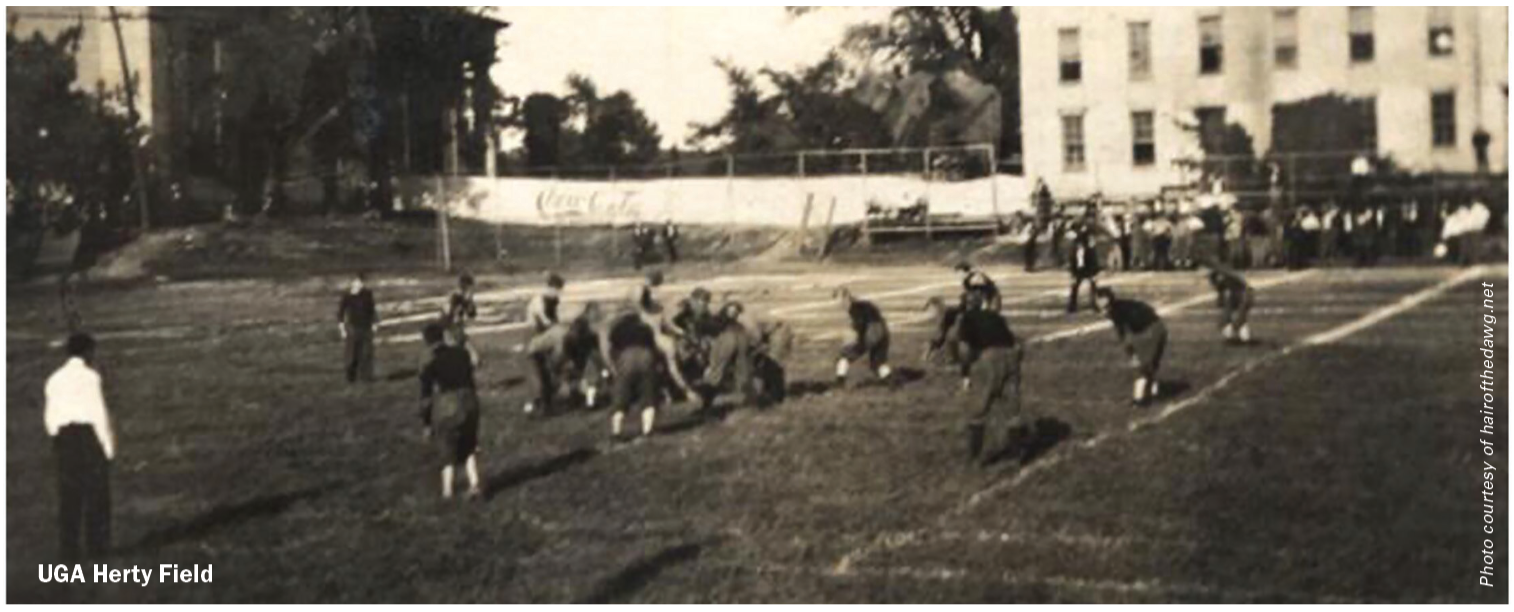
Though Herty Field in Athens was Georgia’s designated home field, in the late 1800s and early 1900s, UGA played games at venues throughout the state. Between 1892 and 1894, Georgia entertained a paltry 1-2 record at Herty Field but was unbeaten in three games in Augusta during the stretch. Moreover, between 1892 and 1925, Georgia posted an 11-1-2 record in Augusta, likely making Augusta’s old Fairgrounds the ‘Dawgs winningest site by percentage (91.7) in school history.
In 1907, the Georgia Bulldogs and Clemson Tigers commenced a seven-game football series at Fairgrounds along the bottom of Milledge Road. Fabled coach John Heisman had built Clemson into a powerhouse during his career with the Tigers between 1900 and 1903. By 1906, Georgia had lost seven straight games (1900-1906) to Clemson and was outscored 185-25 in games leading up to host-city status in Augusta. Clemson likely felt it would continue to handle Georgia no matter where the games were played. The Dawg’s football fortunes were about to change courtesy of Augusta!
Staged in early November in conjunction with the Georgia-Carolina Fair, the contests took place on the infield of the fairground racetrack. Stands were erected for the big games as the rivalry drew immense interest throughout the two-state area. The initial game in the series was set for Thursday, November 7, 1907. The Augusta Chronicle carried a quarter-page gameday ad: “And Today Will be the Great Day of All at the Fair Grounds - Georgia vs. Clemson Football - Game Called Promptly at 3 O’clock - The Manhood and Beauty of Two States Will be There - Go Early to Secure Desirable Seats.” And so, it came to be.
The ‘Dawgs won 8-0 to break the long drought, and when managers tallied gate monies that evening, they were pleasantly surprised to find that “actual receipts had far exceeded expectations.” Organizers sold 12,612 tickets to the fairgrounds on game day. In the early years of college football, attendance figures for games were often not significant enough to be reported. However, the 1907 game in Augusta drew an estimated 6,000 to 10,000 spectators. It was an eye-opener. And likely the largest attendance the Bulldogs had played in front of in their young history.
The highly anticipated games in Augusta grew in stature and became the featured attraction of the annual fairs. According to The Chronicle, “Special excursions will be run on the Georgia and Florida and the S. & W. C. Railroads to bring the great crowd of out-of-town supporters of the two teams, and these with the big crowds of Georgia and Clemson students who will be here are expected to furnish a big feature with their strenuous rooting for their favorite (team). The streetcar company has also made special arrangements to handle the crowds who are expected to attend. Special cars will run to the fairgrounds every few minutes, thus eliminating the usual scramble to seats.”
Georgia won the final three games in Augusta to conclude the series with Clemson with a 5-1-1 mark. The ‘Dawgs employed five head coaches during the stretch, while Clemson made do with three. UGA outscored the Tigers 83-26 during the Augusta run. However, despite the immense popularity and source of pride for bragging rights in the two-state area, the rivalry ceased to be played in Augusta after 1913. The following year, the rivalry transitioned to Sanford Field in Athens.
Post-World War I, Georgia returned to Augusta and tied Tulane 7-7 in 1919. The following year, with Augusta absent from the schedule, first-year head coach Herman Stegeman led the ‘Dawgs to a 7-0-1 season and their first National Championship. When Georgia joined the Southern Conference in 1922, their annual game with Clemson was dropped. In 1924, Augusta was back on the ‘Dawgs schedule as a host site but with a different opponent. Georgia handily defeated Furman 22-0 in 1924 and 21-0 in 1925.
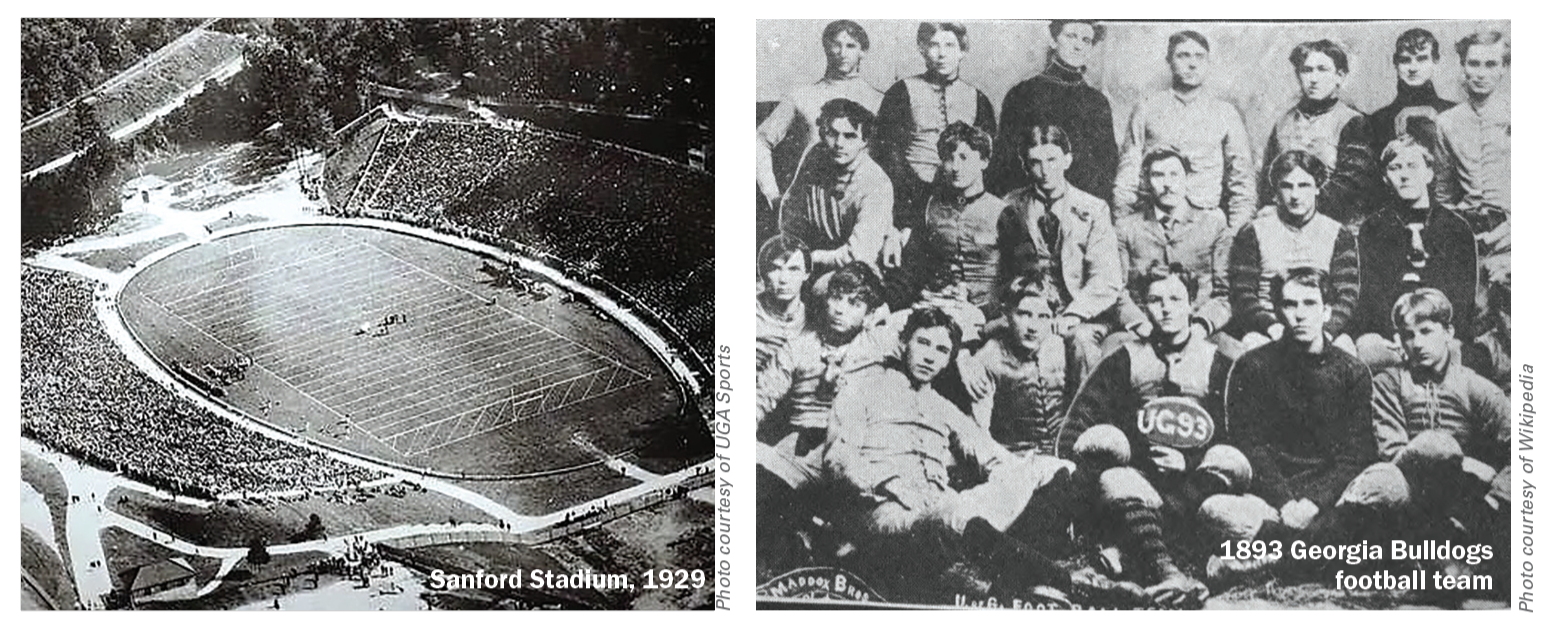
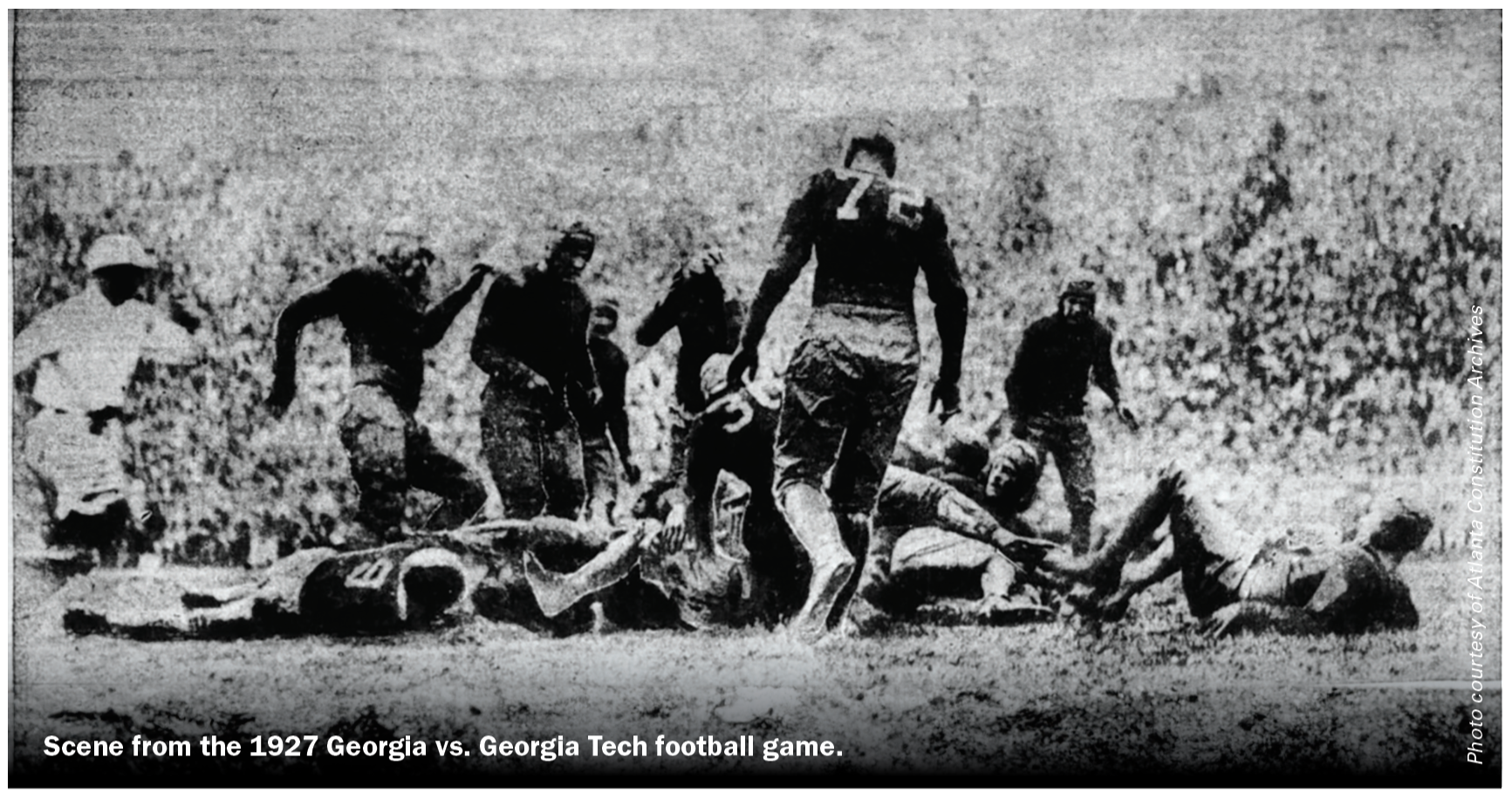
In 1927, Georgia captured its second National Championship, and by 1929, the new 30,000-seat Sanford Stadium was the Dawg’s permanent home site. The following year, Bobby Jones won the Grand Slam of Golf, and in 1931, the sports legend purchased Fruitland Nurseries just up the street from Milledge Road. From then on, golf took the lead as Augusta’s featured sports attraction. Different sport. Same neighborhood. With the same mighty roars sounding throughout Augusta’s Hill Section.
--
Opening photo: University of Georgia, “1927 Georgia Bulldogs,” UGA Special Collections Library Online Exhibitions